


.png)
The Recovery That Too Often Stalls
Guillain-Barré Syndrome is, in many ways, a condition of possibility. Unlike degenerative neurological diseases, most patients with GBS have genuine potential to recover meaningful function, and for many, that means walking again. But the path from diagnosis to independent walking is anything but linear, and the rehab tools available to clinicians haven't always kept pace with what the evidence says works.
The result is a familiar frustration: a patient who could be getting more intensive, task-specific gait training, but isn't because the right equipment isn't in the room, fatigue is hard to monitor in real time, or the therapy team simply doesn't have the hands to support what the research recommends.
This article explores what the evidence says about exercise-based rehabilitation for GBS patients, why fatigue management is the central challenge that can't be ignored, and how the Rise&Walk® robotic rehabilitation system is giving clinicians a practical way to close the gap between what the literature recommends and what actually happens on the rehab floor.
What GBS Does to the Body and Why Walking Is the Central Goal
Guillain-Barré Syndrome is an acute, inflammatory, post-infectious autoimmune polyneuropathy. In plain terms: following an infection (often respiratory or gastrointestinal), the immune system mistakenly attacks the peripheral nervous system – the nerves that carry signals between the brain and the body – causing widespread muscle weakness and sensory changes that typically start in the legs and move upward.¹
Patients often experience symmetrical weakness or paralysis, tingling and burning sensations, loss of reflexes, and changes in balance, joint mobility, and coordination. In moderate to severe cases, the ability to walk is significantly affected, and sometimes lost entirely in the acute phase.
For most patients, recovery happens as the nervous system gradually repairs itself, a process that takes weeks to months and varies widely depending on the type and severity of GBS, the patient's age, and how quickly treatment began. But across the spectrum, getting the patient walking again, ideally independently, is almost universally the primary goal of rehabilitation. It's what drives discharge disposition, quality of life, and long-term independence.
Clinicians treating GBS patients understand this. They're doing everything they can with the tools they have. The challenge is that conventional gait training has real limitations when it comes to what this population actually needs.
What the Research Says: Exercise Works, But Only When Done Right
A 2016 systematic review published in Physiotherapy Canada looked at the available research on exercise interventions for GBS patients, pulling together seven peer-reviewed studies including one randomized controlled trial (RCT).¹
The overall conclusion was clear: various types of exercise programs improve physical outcomes in GBS patients, including the ability to move around independently, cardiovascular fitness, muscle strength, and fatigue levels.¹
The strongest evidence came from a high-quality RCT (Khan et al., 2011) comparing high-intensity versus low-intensity rehabilitation programs in patients in the chronic phase of GBS. The results were compelling:
- 80% of patients in the high-intensity program made meaningful, measurable improvements in their ability to move and function independently, compared to just 8% of patients in the lower-intensity group (p < 0.001).
- The high-intensity group improved more across multiple areas, including mobility, transfers, and walking.
- More patients in the lower-intensity group (41%) experienced functional decline than in the high-intensity group (3%).¹
The review also pointed to a two-phase rehabilitation framework that reflects what GBS recovery actually looks like in practice. The first phase, in the early stages of recovery, focuses on reducing the disability burden. The second phase supports reconditioning and helps patients rebuild function and participation over time.¹
This two-phase approach is exactly what clinicians are already trying to accomplish. The question is whether they have the right tools to pull it off.
The Fatigue Problem: Why GBS Is Different From Every Other Neuro Patient
Here is the clinical reality that separates GBS from stroke, TBI, or SCI rehabilitation: in GBS, over-exercise is not only counterproductive, it can be irreversible.
Overworking partially denervated muscles can cause the loss of functioning motor units, which is damage that does not recover.¹ Research has shown that vigorous physical exercise, even after the disease has stabilized, can elicit a temporary loss of function.¹ Perhaps most concerning for long-term outcomes, losing motor units is linked to central fatigue, which may explain why some patients continue to experience chronic fatigue for years after GBS resolves.¹
For clinicians, this creates a challenging balancing act. Push too little, and the patient won't make the gains the research shows are possible. Push too hard, and the patient may experience worsening weakness, excessive fatigue, delayed recovery, or functional setback. In a traditional gym setting, where one clinician is already managing patient safety, verbal cues, and physical support, staying in that window is genuinely difficult.
That's what makes GBS unlike almost every other patient population a clinician treats. The tool you choose isn't just a preference, it's a clinical decision.
How Rise&Walk Maps to the Two-Phase Recovery Model
The Rise&Walk® 3-in-1 robotic rehabilitation system was designed to meet patients where they are across the full recovery continuum. For GBS patients, that design philosophy maps directly onto what the two-phase rehabilitation framework calls for.
Phase 1 — Early Recovery: Seated Mode and Supported Gait Training
In the acute and early recovery phases, GBS patients often can't safely bear their full body weight or walk without significant assistance. The Rise&Walk addresses this with two approaches that can be used depending on where the patient is in their recovery.
In seated mode, patients can begin gait training from a fully supported position, getting repetitive leg movement without the demand of standing upright. This is especially valuable for patients who aren't yet ready for weight-bearing but still benefit from the active, task-specific movement that drives recovery.
In gait mode, the system can offload the majority, or even all, of the patient's body weight, allowing them to move through the mechanics of walking before they have the strength to do so independently. Clinicians can gradually reduce the amount of support as the patient progresses, making intensity adjustments in real time based on how the patient is responding.
Either way, this is active engagement within the recovery process, not passive support. The evidence strongly supports early, active intervention as the approach that reduces the disability burden and sets the trajectory for better long-term outcomes.
Phase 2 — Reconditioning: Walking Mode
As the patient progresses, gait mode enables high-repetition, intensity-appropriate walking training in a controlled environment. The clinician can adjust support levels and track exertion in real time, without needing to physically assist the patient through every step.
The RPE Advantage
Rise&Walk’s built-in Rate of Perceived Exertion (RPE) mode gives clinicians a real-time tool to guide therapeutic intensity and monitor patient effort during each session. For individuals recovering from GBS, where fatigue management is essential, this added layer of monitoring helps clinicians move beyond visual observation alone. By capturing session-level exertion data, Rise&Walk supports more informed dosing decisions, helping clinicians challenge patients appropriately while avoiding the overexertion that can interfere with recovery.
Safe Patient Handling and Staffing Efficiency
GBS patients can require significant physical support, particularly during ambulation. Rise&Walk's harness and support structure keeps patients safe throughout the session without requiring the clinician to provide manual stabilization, freeing them to focus on the quality of the patient's movement rather than managing fall risk.
Rise&Walk is designed for single-clinician operation, a meaningful advantage in any inpatient rehab environment where staffing ratios are real constraints and time per patient is finite.
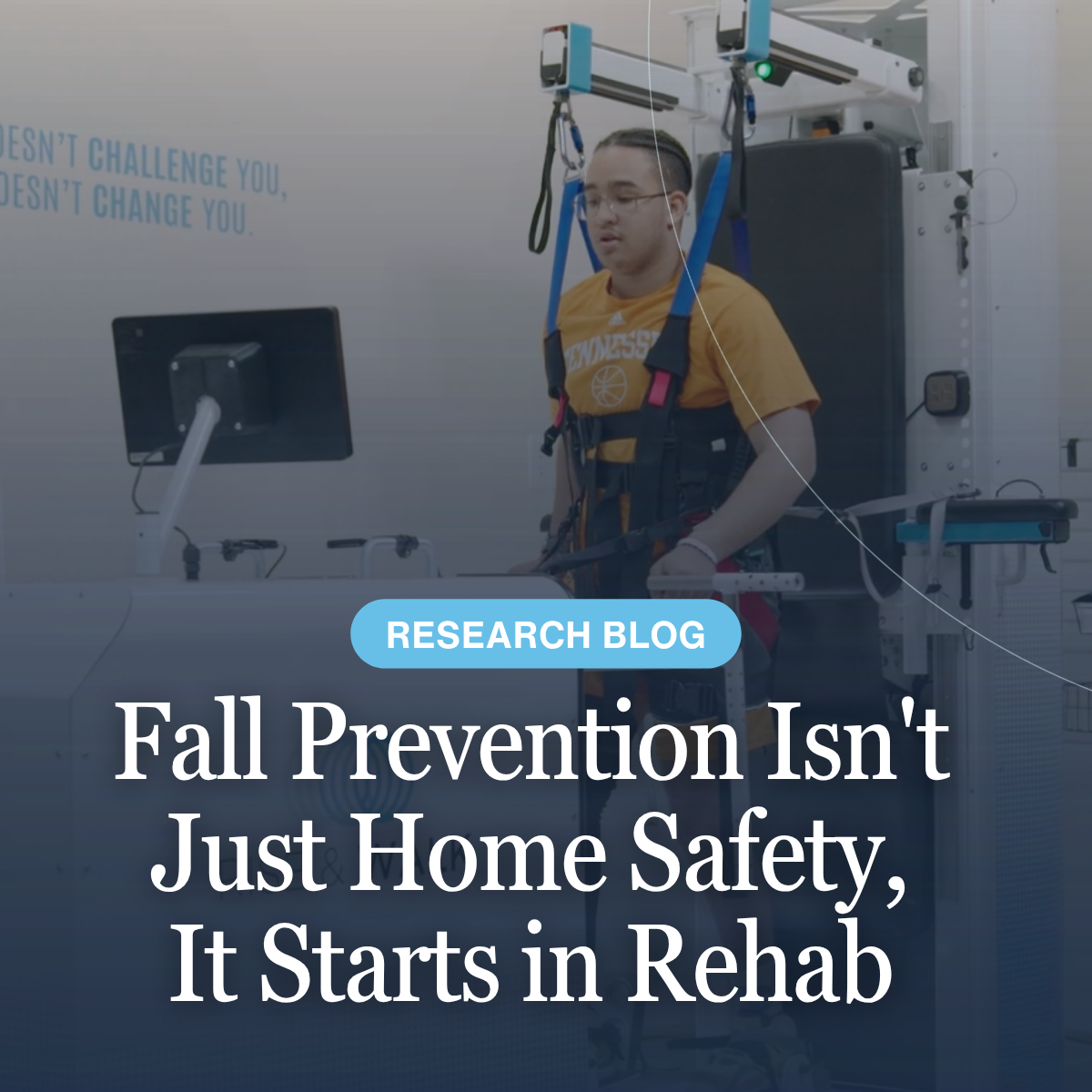
What One Session Looked Like: Miguel at Mountain Valley Regional Rehabilitation Hospital
In his first Rise&Walk session, Miguel’s clinician measured his 10-Meter Walk Test before and after approximately 20 minutes of active gait training.
Before the session, Miguel walked at a comfortable speed of 0.53 m/s and a fast speed of 0.75 m/s. After the session, his comfortable speed improved to 0.71 m/s (a 26% increase), and his fast speed improved to 0.90 m/s (a 17% increase).
Clinically, that matters. Gait speed is one of the most practical ways to describe functional walking ability. Speeds below 0.4 m/s are commonly associated with household ambulation, 0.4–0.8 m/s with limited community ambulation, and speeds above 0.8 m/s with community ambulation. Miguel’s comfortable walking speed moved meaningfully within the limited community ambulation range, while his fast walking speed crossed the commonly cited community ambulation threshold.
Distance told a similar story. Miguel’s typical overground gait session covered approximately 700 feet. During the same 20-minute period on Rise&Walk, he completed 1,100 feet, a 57% increase in walking distance, with no adverse events.
One session does not prove long-term recovery, but it does show what becomes possible when a patient can safely access more repetitions, more walking time, and a higher therapeutic dose without requiring continuous hands-on support from multiple clinicians.
Closing the Gap
The research is clear: progressive intensity, task-specific exercise meaningfully improves outcomes for GBS patients, and the gap between high-intensity and low-intensity rehabilitation is anything but small. It's the difference between 80% of patients making meaningful functional gains and 8%.¹
Clinicians already know what works. The harder question is how to actually deliver it, with enough intensity to matter, enough safety to prevent setbacks, and enough efficiency to fit into a real clinical day.
Rise&Walk gives clinicians the ability to do exactly that, with the flexibility to meet GBS patients in Phase 1, the capacity to drive reconditioning in Phase 2, and the real-time monitoring tools to manage the fatigue risk that makes this population unlike any other.
The missing piece in GBS rehab isn't a new protocol, it's the right tool to execute the one we already have.
Interested in learning how Rise&Walk is being used to improve gait outcomes for patients like Miguel? Contact our team or request a demo to see the system in action.
¹ Simatos Arsenault N, Vincent P, He Shen YB, et al. Influence of Exercise on Patients with Guillain-Barré Syndrome: A Systematic Review. Physiotherapy Canada. 2016;68(4):367–376. doi:10.3138/ptc.2015-58
.png)
